Controls on the temperature of the produced fluid in a double well ATES system
by Emma Lepinay and Andrew W. Woods
This article investigates the temperature evolution of a double-well low-temperature aquifer thermal energy storage system consisting of a hot and a cold permeable reservoir in the subsurface. The wells are used cyclically to provide a supply of thermal energy in the winter and a thermal sink in the summer. The system is paired with a heat pump at the surface which can raise the temperature of the aquifer fluid, to meet the heating demand in the winter, and can also drop the temperature of the aquifer fluid, to meet the cooling demand in the summer. These systems provide a low-carbon solution for space heating and cooling, which currently makes up over a third of the greenhouse gas emissions the UK.
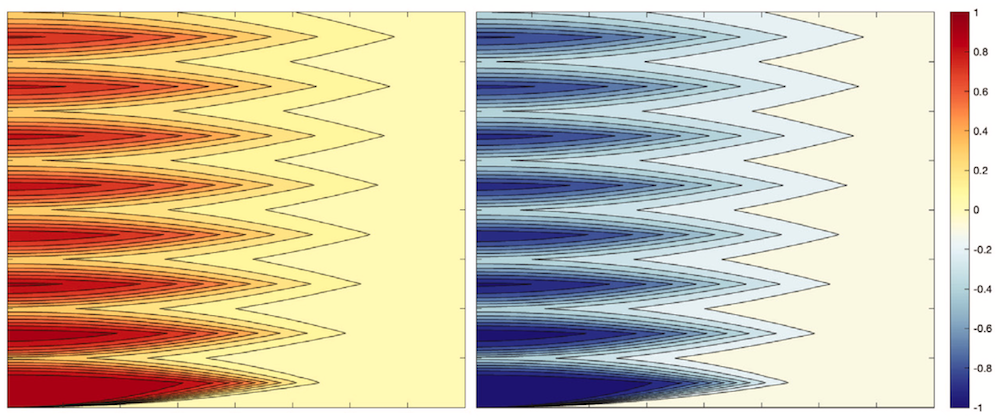
The paper shows how fundamental modelling of the complex heat transfer in the geological formation can help identify the optimal operating principles for ATES systems. The modelling focuses on coupled wells where the extraction temperature of one well, as well as the temperature change imposed by the heat pump, determines the injection temperature of the other well. The season in which the system is started is found to have a significant impact on the extraction temperatures of both wells in the first 5–10 cycles.
The article compares the electricity usage in the heating season of a double well ATES system with a simple system which extracts at the ambient temperature of the aquifer. It shows that a double well system started in the summer can have an average reduction of 9.9% in its electricity usage for heating over 20 years. Conversely, a system started in the winter can have an average reduction of 7.1 % over 20 years.